








Bass


Read more Bass
Read more Bass
What is a bass?
A bass is a musical instrument that produces tones in the low pitch range C4-C2. Basses belong to various instrument families and can cover a wide range of musical roles. Since it typically requires a long column of air or string to produce low pitches, string and wind bass instruments are usually the largest instruments in their families or instrument classes.
It can often be difficult to categorize instruments. For example, some instruments fall into more than one category. The cello is considered a tenor instrument in some orchestral settings, but in a string quartet, it is the bass instrument, whereas an electric bass (bass guitar) will always fall under string instruments.
The history behind the bass guitar
In the 1930s, musician and inventor Paul Tutmarc from Seattle, Washington, developed the first electric bass guitar in its modern form, a fretted instrument designed to be played horizontally. The 1935 sales catalog for Tutmarc's company Audiovox included his "Model 736 Bass Fiddle," a solid electric bass guitar with fire strings, a scale of 30 + 1/2 inches (775 millimeters), and a single pickup. Around 100 were made during this period. Audiovox also sold their “Model 236” bass amplifier.
In the 1950s, Leo Fender and George Fullerton developed the first mass-produced electric bass guitar. The Fender Electric Instrument Manufacturing Company began producing the well-known Precision Bass, also known as P-Bass, in October 1951. The design featured a simple unshaped "slab" body design and a single coil pickup similar to a Telecaster. By 1957, this looked more like the Fender Stratocaster with the body edges cut for comfort, and the pickup was changed to a split-coil design.
Fender Bass was a revolutionary instrument for performing musicians. Compared to the large, heavy upright bass, which had been the main bass instrument in popular music from the early 20th century to the 1940s, the bass guitar was easily transportable to shows. With amplification, the bass guitar was also less prone than acoustic basses to unwanted sound feedback. The addition of tapes allowed bassists to play in melody more easily than on bandless acoustic or electric upright basses, and made it easier for guitarists to transition to the instrument.
In 1953, Monk Montgomery became the first bassist to tour with the Fender bass in Lionel Hampton's post-war big band. Montgomery may also have been the first to record with the electric bass on July 2, 1953, with the Art Farmer Septet. Roy Johnson (with Lionel Hampton) and Shifty Henry (with Louis Jordan and His Tympany Five) were other early Fender bass pioneers. Bill Black, who played with Elvis Presley, switched from upright bass to Fender Precision Bass around 1957. The bass guitar was intended for both guitarists and upright bassists, and many early pioneers of the instrument, such as Carol Kaye, Joe Osborn, and Paul McCartney, were originally guitarists.
Also in 1953, Gibson released the first violin-shaped electric bass on a small scale, the EB-1, with an extendable endpin, allowing a bassist to play it upright or horizontally. In 1958, Gibson released the maple-bowed EB-2, described in the Gibson catalog as a "hollow body bass that has a bass/baritone push-button for two different tone characteristics." In 1959, these were followed by the more conventional EB-0 bass. The EB-0 resembled a Gibson SG in appearance (although the earliest examples have a slab-sided body shape closer to the double-cut Les Paul Special). The Fender and Gibson versions used bolt-on and set necks.
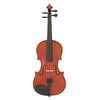
Several other companies also began producing bass guitars during the 1950s. At the 1956 German trade fair "Musikmesse Frankfurt," the distinctive Höfner 500/1 violin-shaped bass was showcased, manufactured by using violin construction techniques by Walter Höfner, a second-generation violin luthier. Due to its use by Paul McCartney, it became known as the "Beatle bass." In 1957, Rickenbacker introduced the 4000 model, the first bass with a neck-through-body design, where the neck is part of the body wood. Kay Musical Instrument Company began production of the K-162 in 1952, Danelectro released the Longhorn in 1956, and Burns London / Supersound in 1958.
