








Cajons
(30 products) In stock (20+ pcs) Delivery time: 3–4 business days
 In stock (20+ pcs) Delivery time: 3–4 business days
 In stock (10+ pcs) Delivery time: 3–4 business days
 In stock (5 pcs) Delivery time: 3–4 business days
Latin Percussion
Latin Percussion Cajon Americana Flamenco Exotic Cedar Wire (LP1446)
€484,95Unit price /Not availableExternal warehouse. Estimated delivery in 10–12 business days. 
Latin Percussion
Latin Percussion Cajon 3D Cube String Cajon (LP1423)
€288,95Unit price /Not availableExternal warehouse. Estimated delivery in 10–12 business days. 
Latin Percussion
Latin Percussion Cajon Americana Series Angled Surface (LP1433)
€258,95Unit price /Not availableExternal warehouse. Estimated delivery in 10–12 business days. 
External warehouse. Estimated delivery in 10–12 business days. 
Latin Percussion
Latin Percussion Cajon Aspire Accents - Havana Café (LPA1332-HC)
€183,95Unit price /Not availableExternal warehouse. Estimated delivery in 10–12 business days. 
Latin Percussion
Latin Percussion Cajon City 2-Voice Cajon - LP1428NY2V
€172,95Unit price /Not availableExternal warehouse. Estimated delivery in 10–12 business days. 
Latin Percussion
Latin Percussion Cajon Giovanni Stave Tumba - Giovanni (M1406GIO)
€330,95Unit price /Not availableExternal warehouse. Estimated delivery in 10–12 business days. 
Latin Percussion
Latin Percussion Cajon Matador Adjustable Wire (LP1426)
€264,95Unit price /Not availableExternal warehouse. Estimated delivery in 10–12 business days. 
Latin Percussion
Latin Percussion Cajon Matador Inside Pedal (LP1400NWP)
€656,95Unit price /Not availableExternal warehouse. Estimated delivery in 10–12 business days. 
Latin Percussion
Latin Percussion Cajon Mona Tavakoli `Lil MT Box Cajon - LP1443L
€133,95Unit price /Not availableExternal warehouse. Estimated delivery in 10–12 business days. 
Latin Percussion
Latin Percussion Cajon Mona Tavakoli MT Box Cajon - LP14431
€277,95Unit price /Not availableExternal warehouse. Estimated delivery in 10–12 business days. 
Latin Percussion
Latin Percussion Cajon Pedrito Martinez Stave Tumba (LP1406-PM)
€256,95Unit price /Not availableExternal warehouse. Estimated delivery in 10–12 business days. 
Latin Percussion
Latin Percussion Cajon Round Back Bass Cajon - LP1461
€284,95Unit price /Not availableExternal warehouse. Estimated delivery in 10–12 business days. 
Latin Percussion
Latin Percussion Cajon Round Back Bass Cajon - LP1461M
€310,95Unit price /Not availableExternal warehouse. Estimated delivery in 10–12 business days. 
External warehouse. Estimated delivery in 10–14 business days. 
External warehouse. Estimated delivery in 10–14 business days. 
External warehouse. Estimated delivery in 10–14 business days. 
External warehouse. Estimated delivery in 10–14 business days. 
External warehouse. Estimated delivery in 10–14 business days. 
External warehouse. Estimated delivery in 10–14 business days. 
External warehouse. Estimated delivery in 10–14 business days. 
External warehouse. Estimated delivery in 10–14 business days. 
External warehouse. Estimated delivery in 10–14 business days. 
Latin Percussion
Latin Percussion Cajon Americana 2-Voice Snare Cajón - 10" (LP1410S)
€117,95Unit price /Not availableExternal warehouse. Estimated delivery in 10–12 business days. 
Latin Percussion
Latin Percussion Cajon Americana 2-Voice Snare Cajón - 12" (LP1412S)
€125,95Unit price /Not availableExternal warehouse. Estimated delivery in 10–12 business days. 
External warehouse. Estimated delivery in 6–8 business days.


Read more Cajons
Read more Cajons
Cajon - more than just a box!
A cajon is a percussion instrument that originates from Peru and is traditionally used in flamenco music. However, the instrument has also made its way to many small duos and trios in our regions, where the cajon excels by being able to take the place of a drum set but in much less space and even at extremely low volumes. Therefore, it has become a favorite instrument for many drummers and percussionists who play party music.
What is a cajon made of?
In Spanish, cajon means drawer or box, and the instrument consists of a wooden box that you sit on while playing. Depending on which flamenco style it is used for, the cajon drum can have different sizes and formats.
The surface consists of sheets of 1.3 to 1.9 cm thick plywood. The front of the box, which you play on, consists of a thinner sheet, and on the back of the instrument, there is a hole, just like we know it from many acoustic drums. Here, sound can 'escape' - and this is also where you would typically place a microphone if the cajon needs to be amplified - preferably along with a secondary microphone on the front for the high snare-like hits.
Originally, cajons were just simple wooden boxes, but in newer versions, there can be guitar strings mounted on the inside of the box, which gives a scratching and raw sound when you hit the cajon. Additionally, some modern cajons have rubber feet and cushions for better seating comfort - especially if you need to play for an extended period.
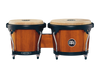
There are also fun variants of the cajon that resemble bongo drums or a small cajon that is perfect for taking along.
How do you play the cajon?
You sit sideways on the box, tilt it slightly, and hit the front side, which is positioned between your knees.
By hitting the cajon drum with your palms and fingers, you can produce different sounds. Some also use a cajon pedal or a type of drumsticks called brushes - find our large selection of brushes here.
Depending on how and where you hit the cajon, the box will produce different sounds. If you hit the middle of the front of the cajon, you will get a darker and deeper sound that can resemble a bass drum sound. If you hit the edge, it gives a more scratching sound that resembles a snare drum sound. Additionally, you can use your right foot to dampen the cajon - just press on the front with your heel, and the sound becomes more controlled. In this way, you can use the cajon both as a pure percussion instrument or as a replacement for the drums in a band. The cajon generally has a very pleasant woody sound that blends well with other acoustic instruments. The reason it has become so popular is also that it is as easy as anything to throw the cajon bag over your shoulder and head off to a gig, a rehearsal, or a campfire!
But be careful with your back - it is important to find a good position to sit in when playing the cajon. Try to keep your back as straight as possible; otherwise, it can quickly become an uncomfortable position.
Cajons come with several different types of surfaces and are available in various price ranges. Some have beautiful patterns, so there is plenty of opportunity to express yourself visually, even if your instrument is 'just' a wooden box ;)
Oh yes - and if you are wondering how to pronounce it, it's "cajon" or "karong":)
Read more about cajons on Wikipedia: Click here
See our large selection of cajons and accessories here.
