







Audio Cable Reels – what are they, and who are they for?
Audio Cables on reels are the flexible solution for anyone who wants proper, reliable audio installations without compromising on length or quality. Instead of pre-made cables in fixed lengths, you get bulk cable by the metre or full reels, which you can tailor precisely to your setup. At SoundStoreXL you’ll find, among other things, Microphone Cables on reels and transparent Speaker Cables that are suitable for home use, studio, live setups and permanent installations.
In this guide, we go through which types of Audio Cable Reels you can get, when they make sense, how to choose the right gauge and quality, and how to get the most out of your installation – whether you need to run cables in a rehearsal room, create a discreet home cinema or build a mobile PA setup.
Introduction to audio cables – the key basics
Before choosing Audio Cable Reels, it helps to know the difference between the most common cable types and signal formats. This makes it easier to choose the right cable type the first time and avoid noise, hum and unnecessary audio loss.
Basically, you work with two main types of audio cables:
- Microphone and signal cables – typically balanced XLR or TRS connections for microphones, mixers, audio interfaces and line signals.
- Speaker Cables – unbalanced cables that carry an amplified signal from an amplifier or PA power amplifier out to the speakers.
In addition, there are specialist types such as guitar and instrument cables, multicables and installation cables, but in this collection we primarily focus on microphone cable reels and speaker cable reels, which cover the vast majority of practical audio tasks.
Balanced connections (as with most microphone cable reels) are especially suitable for longer cable runs because they can suppress noise and hum more effectively. Unbalanced connections typically use fewer conductors and are more vulnerable to noise, but work fine for short runs and speakers, where the signal is already amplified.
Types of Audio Cable Reels at SoundStoreXL
The selection of Audio Cable Reels at SoundStoreXL is put together for the practical user, the installer and the audio enthusiast alike. In this collection, you will mainly find these types:
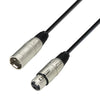
- Microphone cable reel in professional quality – for example Perfex microphone cable reel, supplied in 100 metres.
- Standard microphone cable on a reel for versatile audio tasks – a black, flexible signal cable that can be used as a guitar cable, microphone cable or XLR cable depending on which connectors you fit.
- Transparent speaker cable 2 x 2.5 mm² on a reel – a clear speaker cable that’s ideal for both hi-fi, home cinema and PA installations where you want low loss and a sensible conductor gauge.
What audio cables on reels have in common is that you get a long continuous length that you can cut to size as needed. This lets you tailor your cable routing so you can avoid couplers, adapters and cables that are too short.
Advantages of audio cables on reels compared to ready-made cables
For many users, audio cables on reels are a more flexible and cost-effective solution than ready-made cables. Here are some of the biggest advantages:
- Custom lengths: You cut exactly the length you need for each cable run.
- Less cable clutter: You avoid unnecessarily long cables lying around, resulting in a more professional and safer setup.
- Fewer joints: Fewer adapters and joints often mean more reliable audio and less risk of noise and dropouts.
- Better for fixed installations: Perfect for installation in walls, ceilings, cable ducts and racks, where you want neat, permanent solutions.
- Cost savings on larger systems: For larger projects, reel cable can be cheaper per metre than buying many individual cables.
That’s why audio cables on reels make particularly good sense when you need to build a complete solution – for example a new rehearsal room, a conference hall, a small venue or a dedicated home cinema, where the cables need to be concealed and in exactly the right lengths.
Length and thickness – how long and how thick cables should you choose?
When you work with speaker cables on reels, both length and conductor thickness are important factors for sound quality and reliability. For microphone cables on reels, shielding and balanced wiring are crucial, but length still plays a role.
A good rule of thumb for speaker cable is:
- Up to around 10 metres: 1.5 mm² may be sufficient for smaller systems.
- 10–20 metres: 2.5 mm², like the transparent 2 x 2.5 mm² speaker cable, is often a good choice for both hi-fi and PA.
- Over 20 metres or high loads: Consider a thicker cable if the system draws many watts and is driven hard.
The longer the cable run and the lower the speaker impedance, the more important it is to choose a sensible gauge, so you avoid unnecessary voltage drop and loss of bass control.
For microphone cables on reels, a balanced design with two conductors plus shield is standard. Here it’s more about the cable having good shielding, sensible capacitance and a flexible, hard-wearing outer jacket – exactly what you’ll find in the microphone cables in this collection.
Quality and performance – what should you look for?
The quality of an audio cable on a reel isn’t just about thickness, but the entire construction. The key points you should pay attention to are:
- Conductor material: Good-quality copper ensures low resistance and stable performance. Several of the microphone cables in the collection are made with OFC copper (oxygen-free copper) for better conductivity.
- Shielding: Microphone Cables in reels with braided copper shielding and a high shielding coverage reduce hum and electromagnetic noise, which is crucial in studios, PA racks and stage environments.
- Insulation and jacket: A robust and flexible outer jacket makes the cable easy to pull and resistant to kinks and wear. For example, Perfex microphone cable on a reel is made from a soft, yet hard-wearing material.
- Electrical data: Capacitance, line resistance and temperature tolerance are relevant for long runs and demanding installations.
With Speaker Cables in reels, the focus is primarily on conductor cross-section, copper quality and insulation, while shielding typically isn’t used in the same way as with signal cables. A transparent speaker cable of 2 x 2.5 mm² strikes a very good balance between flexibility, price and performance for both music and film.
Installation and use of Audio Cable Reels
One of the big advantages of Audio Cable Reels is that you can tailor the installation precisely to your needs. However, it does require a bit of planning and correct handling.
- Plan cable runs: Measure the distance from equipment to equipment and add a little extra to allow for neat bends and strain relief.
- Stripping: Use proper wire strippers so you don’t damage the conductors when preparing the cable for soldering or connector assembly.
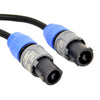
- Connector types: For Microphone Cables in reels, you typically use XLR or TRS connectors. For Speaker Cables, Speakon or banana plugs are often used, or screw terminals on amplifiers and speakers.
- Separate audio and power: Route Audio Cables away from 230 V power cables where possible, especially for microphone and signal cables.
- Fixed installation: For permanent installations through walls and ceilings, you should follow the applicable regulations for cable ducts, penetrations and strain relief.
When working with Audio Cable Reels, it especially makes sense to unwind the cables neatly and avoid sharp kinks, so the jacket and conductors aren’t damaged when pulled. With repeated use in live settings, it can be an advantage to use a cable drum or Velcro straps to keep the cables organised.
Winding, storage and handling – how to make your cables last longer
Correct winding and storage matters a lot for the lifespan of your Audio Cable Reels. Poor handling can cause kinks, breaks and unstable connections, even with high-quality cables.
- Coiling: Use the same technique professional technicians use – coil the cable in large, smooth loops without forcing it. Avoid twisting the cable when coiling it up.
- Storage: Store Audio Cable Reels dry and at moderate temperatures. Avoid moisture and direct sunlight for long periods.
- Protection: For transport and live use, it can be a good idea to use cable bags or cases so the cable is not crushed by heavy equipment.
- Cable runs in installations: Make sure cables are not hanging from their own connectors, but are mechanically strain-relieved, e.g. in a rack or in cable trays.
Your Audio Cable Reels perform best when treated like a piece of precision equipment. A little care in everyday use pays off in fewer faults, less noise and a longer service life, especially when you work with many metres of cable in studios or PA setups.
The difference between professional and standard Audio Cable Reels
There is a clear difference between very cheap cables and professional Audio Cable Reels when you look at construction and durability. In practice, it comes down to how the cable is designed in relation to the use case.
- Professional use: Here the focus is on robustness, flexibility and low noise. Microphone Cables on reels for stage use typically have a heavy outer jacket, good shielding and flexible conductors that withstand repeated coiling.
- Installation use: Here, easy pulling, long service life and discreet mounting are often prioritised. Speaker Cables on reels for installation are often chosen based on conductor thickness and colour, so they can be easily hidden.
- Home and hobby: Here you can often get by with more affordable solutions, but still with sensible copper quality and insulation so the system sounds as it should.
The cable solutions in this collection sit at the end where you get professional usability without paying for unnecessary gimmicks. You get Audio Cable Reels that can be used both for serious hobby use and for tasks in smaller professional environments.
Popular cable types and applications
Instead of focusing on many different brands, the selection here is centred around a few proven types of Audio Cable Reels that cover the most common needs:
- Perfex microphone cable on reel (100 m): A professional standard microphone cable in a soft but durable material. Suitable for XLR cables, signal cables between mixer and amplifier, or as a flexible installation cable in rehearsal rooms and smaller stages.
- Microphone cable on reel (black, 100 m): A versatile signal cable that can be used for many types of audio tasks, including as a guitar cable, microphone cable and XLR cable. OFC copper, braided shielding and good flexibility make it ideal for both mobile and fixed use.
- Transparent speaker cable 2 x 2,5 mm²: A transparent speaker cable that is ideal for both hi-fi setups, home cinema and smaller PA solutions. Good conductor thickness provides low loss over moderate and slightly longer runs.
By combining these cable types, you can build almost any common audio setup – from microphone to mixer and on to amplifier and speaker – based solely on Audio Cable Reels and the connectors that fit your equipment.
Compatibility
Audio Cable Reels are not dependent on specific solutions in themselves, but they are the link between your physical gear and the digital audio world. When choosing cables, compatibility is first and foremost about the connectors matching your mixer, your audio interface, your microphones and your speakers.
Microphone Cables on reels are typically used with XLR connectors for microphones, mixers and audio interfaces, which you can connect to your DAW or other music software on a computer. Speaker Cables on reels are used for the terminals on passive speakers and the outputs on power amplifiers or receivers. If you use, for example, DJ software or other playback software in your setup, it’s still your analogue Audio Cable Reels that ensure the signal safely reaches the audience or listener.
Whether the sound comes from a computer, a DJ controller or a traditional mixer, well-chosen Audio Cable Reels ensure that the signal is transported reliably from A to B without unnecessary noise and loss.
FAQ – typical questions about Audio Cables
When you work with Audio Cable Reels, the same questions often come up. Here you’ll find short, practical answers that can help you make the right choice.
How long can Speaker Cables be?
There is no fixed limit to how long Speaker Cables can be, but the longer the cable, the greater the risk of loss. For typical home installations, runs of 5–10 meters with 2.5 mm² cable are rarely a problem. Over longer distances, you should choose a heavier-duty cable and pay attention to the speakers’ impedance and the amplifier’s capacity.
How thick should speaker cable be?
For smaller speakers and short distances, 1.5 mm² may be sufficient, but for hi-fi, home cinema and PA over slightly longer runs, 2.5 mm² is generally a safer choice. For very long cable runs or high power, you may benefit from an even thicker cable.
How thick a wire do I need for my system?
Choose thickness based on both length and load. For a standard stereo system in the living room with speakers a few metres away, 1,5 mm² is often perfectly adequate. If you need to run cable across an entire room or further down through a hall, 2,5 mm² typically delivers a more controlled sound, especially in the bass.
Is there a difference between microphone cables
Yes, the difference mainly comes down to shielding, conductor quality, flexibility and durability. Professional microphone cables on reels often have better shielding against noise and a more robust outer jacket that withstands repeated coiling and tougher use. This can be crucial for live and studio use, where cables are moved around daily.
How to choose the right cable on a reel for your needs
To make the choice clear, start with a few specific questions. That way you’ll end up with the right Audio Cable Reels the first time.
- What will the cable be used for? Microphone, line signal, guitar, or speaker?
- How long does it need to be? Measure the run and add a little extra.
- Will it be moved often, or installed permanently? That determines how robust and flexible it should be.
- Which connectors need to be fitted? XLR, jack, Speakon, banana or screw terminals?
- How high is your budget, and how critical is the sound? Choose quality based on use and importance.
If, for example, you want to build a simple but reliable PA setup in a rehearsal room, you can use microphone cable on a reel for all your XLR connections between microphones and mixer, while transparent 2 x 2,5 mm² speaker cable on a reel carries the signal on to the passive speakers. For home cinema or hi-fi, you can use the same speaker cable to run neat, discreet lines between receiver and speakers around the living room.
Buy Audio Cables at SoundStoreXL
When you choose Audio Cables such as XLR Cables at SoundStoreXL, you get solutions selected for serious audio use – whether it’s in the living room, the studio or on stage. You can combine microphone cable on a reel and speaker cable on a reel, so your entire system connects seamlessly from source to speaker. This gives you the freedom to build exactly the solution you want, without being limited by fixed cable lengths.
Use the collection as a starting point, and add the connectors, adapters and any cable ducts that suit your project. If you need help choosing the right type of Audio Cable Reels or calculating suitable lengths and conductor sizes, you can always start with these products and customise them to match your exact installation.
Buy your Audio Cable Reels at SoundStoreXL – 100% Danish retailer.
